


Page 188 - Demo
P. 188
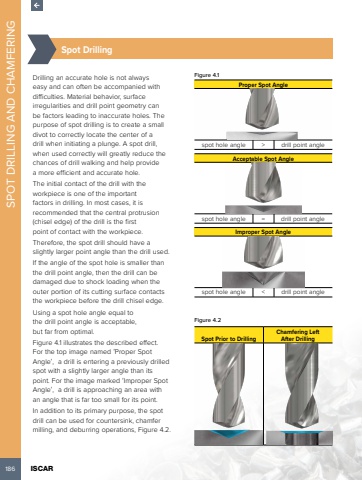
186 ISCAR SPOT DRILLING AND CHAMFERING %u00bd%u0009Spot DrillingDrilling an accurate hole is not always easy and can often be accompanied with difficulties. Material behavior, surface irregularities and drill point geometry can be factors leading to inaccurate holes. The purpose of spot drilling is to create a small divot to correctly locate the center of a drill when initiating a plunge. A spot drill, when used correctly will greatly reduce the chances of drill walking and help provide a more efficient and accurate hole.The initial contact of the drill with the workpiece is one of the important factors in drilling. In most cases, it is recommended that the central protrusion (chisel edge) of the drill is the first point of contact with the workpiece. Therefore, the spot drill should have a slightly larger point angle than the drill used.If the angle of the spot hole is smaller than the drill point angle, then the drill can be damaged due to shock loading when the outer portion of its cutting surface contacts the workpiece before the drill chisel edge.Using a spot hole angle equal to the drill point angle is acceptable, but far from optimal.Figure 4.1 illustrates the described effect. For the top image named %u2018Proper Spot Angle%u2019, a drill is entering a previously drilled spot with a slightly larger angle than its point. For the image marked %u2018Improper Spot Angle%u2019, a drill is approaching an area with an angle that is far too small for its point.In addition to its primary purpose, the spot drill can be used for countersink, chamfer milling, and deburring operations, Figure 4.2.Figure 4.1 Proper Spot Anglespot hole angle > drill point angleAcceptable Spot Anglespot hole angle = drill point angleImproper Spot Anglespot hole angle < drill point angleFigure 4.2 Spot Prior to DrillingChamfering LeftAfter Drilling


