


Page 217 - Demo
P. 217
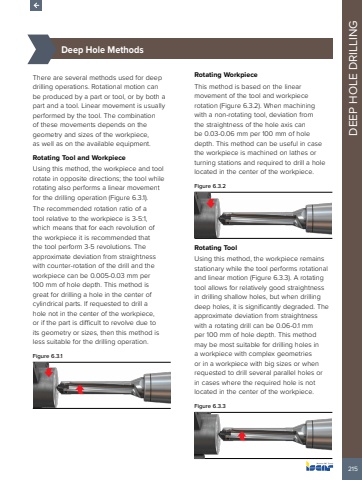
215DEEP HOLE DRILLING%u00bd%u0009Deep Hole MethodsThere are several methods used for deep drilling operations. Rotational motion can be produced by a part or tool, or by both a part and a tool. Linear movement is usually performed by the tool. The combination of these movements depends on the geometry and sizes of the workpiece, as well as on the available equipment.Rotating Tool and WorkpieceUsing this method, the workpiece and tool rotate in opposite directions; the tool while rotating also performs a linear movement for the drilling operation (Figure 6.3.1). The recommended rotation ratio of a tool relative to the workpiece is 3-5:1, which means that for each revolution of the workpiece it is recommended that the tool perform 3-5 revolutions. The approximate deviation from straightness with counter-rotation of the drill and the workpiece can be 0.005-0.03 mm per 100 mm of hole depth. This method is great for drilling a hole in the center of cylindrical parts. If requested to drill a hole not in the center of the workpiece, or if the part is difficult to revolve due to its geometry or sizes, then this method is less suitable for the drilling operation.Figure 6.3.1 Rotating WorkpieceThis method is based on the linear movement of the tool and workpiece rotation (Figure 6.3.2). When machining with a non-rotating tool, deviation from the straightness of the hole axis can be 0.03-0.06 mm per 100 mm of hole depth. This method can be useful in case the workpiece is machined on lathes or turning stations and required to drill a hole located in the center of the workpiece.Figure 6.3.2Rotating ToolUsing this method, the workpiece remains stationary while the tool performs rotational and linear motion (Figure 6.3.3). A rotating tool allows for relatively good straightness in drilling shallow holes, but when drilling deep holes, it is significantly degraded. The approximate deviation from straightness with a rotating drill can be 0.06-0.1 mm per 100 mm of hole depth. This method may be most suitable for drilling holes in a workpiece with complex geometries or in a workpiece with big sizes or when requested to drill several parallel holes or in cases where the required hole is not located in the center of the workpiece.Figure 6.3.3


